|
How Does Geothermal Work?
All geothermal energy systems draw heat from the earth when heating and send heat to the earth when cooling.
The ground heat can be gathered from well water, from pipes buried in the ground, or from water bodies.
In New England, well water is usually the most practical heat source. Ground water from a well is supplied to a heat pump, which concentrates the heat contained within the water, and transfers it to either air or water for distribution throughout your home. The ground water is then returned to the earth, either to the same well, if is sufficiently deep, or to a second well.
To provide cooling, the heat pump transfers heat from the home to the well water and back to the ground.
Ground loops can also be effective in New England for those homes that have sufficient land and no ledge.
For homes with modest energy requirements it is practical to supply all of the heating and cooling from the geothermal system. For homes that have much larger requirements, the most cost-effective approach may be to size the geothermal system to supply some but not all of the required heating, with both systems supplying heat on the coldest days.
How do geothermal heat pumps work?
Heat pumps employ the refrigeration cycle. A refrigerant is boiled (evaporated), compressed, and condensed. The cycle relies on the large amount of energy that is absorbed and released by boiling a liquid to a gas and then condensing that gas back to a liquid. It also relies on the correlation between the pressure and temperature of a gas.
|
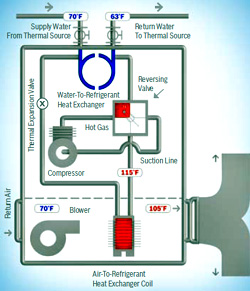
Heating Mode
During the HEATING mode, The refrigerant, in a liquid state, flows through the well water-to-refrigerant heat exchanger (co-axle coil). As it is heated by the well water, it boils (evaporates), changing phase into a cool gas. The compressor greatly increases the pressure of the gas, thus raising its temperature. The gas temperature is raised to 140-160F. The hot gas then passes through the air-to-refrigerant heat exchanger. The refrigerant releases heat to the air from the home, thus warming the air. The cooling causes the refrigerant to condense back to a liquid. |
|
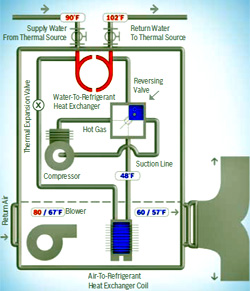
Cooling Mode
During the COOLING mode, The reversing valve reverses the flows, and the process is reversed. The refrigerant liquid flows through the air-to-refrigerant heat exchanger, where it absorbs heat from the air. As it is heated by the home air, it boils (evaporates), changing phase into a cool gas. The compressor greatly increases the pressure of the gas, thus raising its temperature. The gas temperature is raised to 140-160F. The hot gas then passes through the well water-to-refrigerant heat exchanger. The refrigerant releases heat to the well water, thus warming the water. The cooling causes the refrigerant to condense back to a liquid. |
Types of Ground Loop Systems
Open Loop Wells
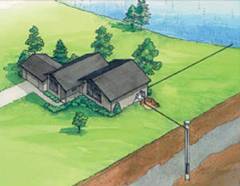
Single well systems (shown) draw water from near the bottom of the well and return the water to just below the water surface. Two-well systems draw water from one well and return it to a second well.
Vertical Loop
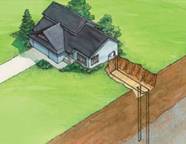
Vertical loops are used when space is limited. Holes are bored using a drilling rig, and a pair of pipes with a special u-bend fitting is inserted into the holes.
Horizontal Loop
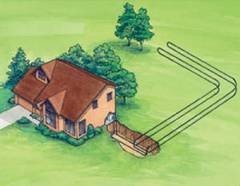
Used where adequate land is available, horizontal loops involve one or more trenches that are dug using a backhoe or chain trencher. Polyethylene pipes are inserted, and the trenches are backfilled.
Pond Loop
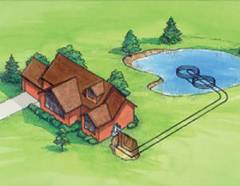
If an adequately sized body of water is close to your home, a pond loop can be nstalled. A series of loops can coiled and sunk to the bottom.
The FHP/Bosch catalogue is a good source for detailed information about geothermal heat pumps, including pictures and descriptions of their various components, performance, warranties, incentives, and more.
Click below to download catalogue

Contact us to find out more
|